Monday, April 29, 2019

Week 15 Reading Notes: Brothers Grimm (Crane), Part A

A depiction of Aschenputtel from the Brothers Grimm story of the same name.

This unit again features famous fairy tales in an earlier and often more raw form from the Brothers Grimm of folklore legend. This unit contains the story of The Fisherman and his Wife, Aschenputtel (known as Cinderella in English), and The Robber Bridegroom. In Aschenputtel, the German version of Cinderella, a plague rips through a village, and a wealthy gentleman’s wife is moments from death. With her last breath she tells her daughter to remain good and kind, and God will protect her. The child visits her mother’s grave every day for a year, then her father remarries another woman. The stepmother has two daughters who are beautiful but cruel and wicked. The stepsisters steal the girl’s nice clothes and jewellery, making her wear rags. They make her do all the chores in the kitchen, naming her Aschenputtel, or Ashfool. She works every day from dawn to dusk, while the other girls mock her constantly, and make more messes for her to clean. Despite this, the girl stays good and kind, returning to her mother’s grave to cry and pray. One day, the gentleman goes to visit a fair, promising to bring back lovely gifts. The eldest asks for dresses, the younger for pearls and diamonds. Aschenputtel only asks for the first twig to knock his hat off on the way. He leaves and returns, giving the gifts to the girls. Aschenputtel plants the twig over her mother’s grave, and waters it three times a day. It grows into a hazel tree, and she prays under it three times a day. A white bird begins to visit her, listening to her prayers, and passing down whatever she asks for. The king is planning a three-day festival, and invites all the maidens of the land so the prince may choose one of them for his wife. The two stepsisters are invited, but Aschenputtel, despite begging them to let her come with them, is not allowed because she has no nice clothes to wear. The girl asks again, and the stepmother throws a dish of lentils in the ashes. She says if the girl can pick up the lentils in less than two hours, she can go. The girl sings a chant, and a flock of doves fly down to help her accomplish this task in less than an hour. The stepmother then throws down twice as many lentils, but the girl cleans these up as well. The stepmother decides she cannot spoil her own daughters’ chances, and leads her husband and daughters away, leaving Aschenputtel behind, crying. Aschenputtel asks the hazel tree for clothes of silver and gold, and the bird drops down a gold and silver dress and silk shoes. She goes to the feast, and the prince dances with her most of all. Sunset arrives, and Aschenputtel asks to leave. The prince escorts her home, but she escapes into a pigeon coop, hiding. The father is already home, and the prince asks him to chop down the pigeon coop, but the girl has already escaped. On the second day of the festival, Aschenputtel appears even lovelier than before, and the prince dances with her the whole day. This time, she escapes by climbing a pear tree. The father is called to chop down the tree and begins to wonder if it is his daughter, but again she is gone. The third day arrives, and the girl is grander than ever, with slippers of gold. The prince smears the entire stairway in an attempt to keep the girl, but Aschenputtel runs away, only a golden slipper sticking in the pitch. The prince announces he will marry the woman whose foot fits that slipper. The prince arrives at the gentleman’s home, and tries the slipper on the eldest stepsister, who cuts off her toes in order to force her foot to fit. The prince and eldest stepsister ride off, but two doves tell the prince that her foot is dripping with blood. He is horrified, and returns to try the shoe on the other stepsister. She has cut off part of her heel, and again the prince is fooled. The doves tell the prince again of the blood, and the prince returns again to ask about any other girl. The gentleman says there is a kitchenmaid, but does not mention she is his own daughter. Aschenputtel is called, washes herself, and the slipper fits. The prince recognises her as the stranger, and the two are married. During the wedding, the two stepsisters are Aschenputtel’s bridesmaids, trying to win back her favor. Doves fly down again, however, and gouge out both stepsisters’ eyes as a punishment they will endure for the rest of this life.

Bibliography: Lucy and Walter Crane's Household Stories by the Brothers Grimm. http://mythfolklore.blogspot.com/2014/07/myth-folklore-unit-brothers-grimm-crane.html

Friday, April 26, 2019

Week 14 Story: Rumpelstiltskin

A depiction of the Brothers Grimm character Rumpelstiltskin from the famous story

One day in a far off kingdom tucked away in a forest, a miller who was working diligently for the king and his kingdom was graced with the presence of the king himself! In an effort to impress the monarch of his land, the miller nonchalantly and falsely bragged that his daughter could spin straw into gold, thinking nothing would come of it. The king, a wealthy and greedy man, ordered the miller's daughter to be taken to his stores of straw and spin them into gold before the morning had come or else he would cut her head off. The daughter tried her hardest all night, but alas, did not have special abilities and could not do the impossible. Right as she was about to give up, a scrawny and harrowing-looking man appeared and told the daughter that he was able to do what she seeks for a deal. The daughter, relieved and thankful, gave him her necklace. The man spun all of the straw into gold in minutes and then left with her necklace.

The king arrived and saw the amazing rumor was true, and the very next night brought her to a bigger room with more straw, seeking to increase his wealth. The same thing happened yet again. The daughter tried very hard to do what the man did, but could not. The man appeared with minutes to spare again, ready to make a deal. The daughter gave him her ring, and the same result occurred. The king was astounded and brought her his largest store of straw in the kingdom with a new deal. If she could spin the straw into gold, he would marry her, and if not, she would be killed. The man again appeared in the dwindling hours of the night to make a deal. The daughter had nothing of value to offer until the man asked for her first-born son. After contemplating, she agreed. The king saw the gold in the morning and married the miller's daughter.

About a year later, the man appeared when the now queen gave birth to a son, demanding payment on his deal. She, however, realized she was the queen of the entire kingdom with an army at its disposal and wealth to live handily forever. She and the king ordered the guards to arrest and imprison the man who dared to try to steal the king's first-born son and heir. The man was arrested and never heard from again, and the king and queen lived happily ever after. 

Author's Note: I decided to take the original story of Rumpelstiltskin and an unusual twist to a story that many people know well. I had always wondered what would have happened if the miller's daughter just told Rumpelstiltskin no and didn't give him her first-born. She marries the king who can imprison the man forever and likely be safe! That idea was the foundation and inspiration for the story.

Bibliography: Grimm Brothers' Children's and Household Tales by Dan Ashliman. http://mythfolklore.blogspot.com/2014/04/myth-folklore-unit-brothers-grimm.html

Wednesday, April 24, 2019

Week 14 Reading Notes: Brothers Grimm (Ashliman), Part A

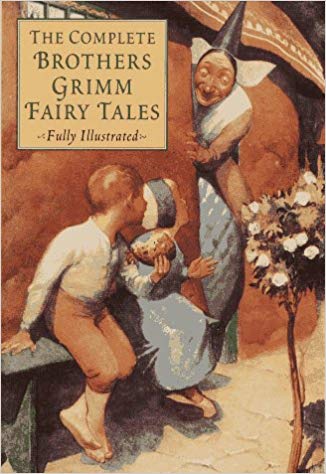
An image of an illustrated book of the many stories popularized by the Brothers Grimm

The Brothers Grimm are an iconic piece of almost everyone's childhood, even still today, and many may be unaware of many stories that are actually by the Brothers Grimm, such as Little Red Cap (Riding Hood) and Rumpelstiltskin. In this unit, many stories, including those two previously mentioned are covered in depth. In The Wolf and Seven Kids, a mother goat has seven kids. She goes to the forest, and warns the kids to keep an eye out for the wolf, who can be recognized by his black feet and rough voice.The wolf comes knocking and disguises his feet and voice. The kids all scramble to hide, but he finds and gobbles up all but the youngest. Mama goat returns and is distraught to only find the youngest at home. They locate the wolf snoozing, and suspect that the other kids are still alive in his belly. The wolf is sleeping so deeply they cut open his belly, and out leap the kids, all safe and sound. They stitch stones into the wolf's belly, and he drowns when he goes to take a drink in the well. In Rumpelstiltskin, a miller, who happens to be talking to the king, brags that his daughter can spin straw into gold. The king has her brought to the castle, and tells her that she'll be killed if she doesn't fulfill this task. She weeps until a little man appears, and agrees to spin for her if she'll give him her necklace. Et voilĂ ! A room full of gold. The same thing happens again, with an even larger room full of straw. This time the little man agrees to take her ring as payment. The third time, the king says she will become his wife if she succeeds. And this time, the little man wants their first-born child. The maiden agrees—what is she gonna do, just die?—and the king marries her. When she gives birth to a child, the little man reappears and reminds her of their bargain. She tries to offer him the kingdom's riches instead, but he prefers a living being. Finally, after she cries a whole lot, he agrees to give her a chance to get out of the bargain by guessing his name in three days. So she spends the next few days guessing every ridiculous name she can think of, while also sending out servants to search far and wide for clues. Finally, on the third day, a messenger gets back to her and says that on a mountain at the edge of the forest, he saw a little man hopping around and chanting a rhyme that contained his name. The queen slyly guesses a few incorrect names before asking whether it's Rumpelstiltskin. The little man is so furious that he tears himself in two.

Bibliography: Grimm Brothers' Children's and Household Tales by Dan Ashliman. http://mythfolklore.blogspot.com/2014/04/myth-folklore-unit-brothers-grimm.html

Friday, April 19, 2019

Week 13 Story: Long Live King Arthur?

A painting of a scene from the famous King Arthur stories of British legend

One fine morning, a little boy by the name of Arthur headed out from his home in Brighton and went to school, as it was in walking distance and his parents both work full-time jobs. Arthur was an interesting and whimsical kid that was really into magic, dragons, mythology and legends, which of course meant that he was bullied by his peers for essentially knowing himself and his identity and interests. After a particularly rough day of being picked on by Ralph and his gang of insufferable peons that bombarded him with insults, Arthur decided to take an alternate route home to avoid the trouble that was surely to be caused if he walked near Ralph and his friends.

On his clever walk home, Arthur stumbled into an abandoned construction site, the ultimate playground for someone like Arthur. After hanging out for a while, Arthur noticed a large metal pole stuck into the ground, seemingly off to the side for no reason. As Arthur approached, he heard a man's voice holler "Who goes there?!" Arthur almost ran instinctively, but decided to face this foe. The man looked to be about 70, and scuttled over to speak with him. The old man explained that only a true king of power and might could pull it out of the ground, showing Arthur that he couldn't do it. Arthur walked over and he easily pulled it out (as it was barely sticking in the ground at all).

The old man erupted and began singing praises to Arthur and his might, which Arthur took to heart and really started to believe about himself. For the rest of his young adult life, Arthur easily tolerated and dismissed is bullies because the opinions of the common people could not be taken seriously. After all, what did commoners know about the life of a king?

Author's Note: I thought it would be funny and interesting to set the premise of the beginning of "King Arthur" in a modern context, and also if Arthur was just some gullible child. I also thought it would be interesting if Merlin was just some ordinary guy that maybe just didn't know what was going on and liked to prank some kid because nothing of consequence really happens, but really ended up giving Arthur some confidence to be himself. 

Bibliography: King Arthur: Tales of the Round Table by Andrew Lang. http://mythfolklore.blogspot.com/2014/05/myth-folklore-unit-king-arthur.html

Thursday, April 18, 2019

Week 13 Reading Notes: King Arthur, Part B

A medieval depiction of King Arthur from British legend

After Sir Bagdemagus fails, Galahad wins a miraculous white shield marked with a red cross. The white knight who defends the shield tells Galahad its history — it comes from the days of Joseph of Aramathy and has healing powers — then the white knight vanishes. Galahad's squire, who has heard all this, asks that he may follow wherever Galahad goes. When Galahad hints that he must ride alone, the squire asks to be knighted. Galahad grants it.

Now Galahad is directed to a churchyard where a ghost howls, weakening men and driving them mad. Galahad lifts the lid of the haunted coffin, drives out a fiend, and orders the body removed from holy ground. A good man explains the allegory in the event: the body signifies the foulness of the world, corrupt with the hatred of fathers and sons — one of the reasons Christ was born of a Virgin.

Galahad and his former squire, now Sir Melias, ride together until the road forks. A magic sign says that the left fork can lead to proof of prowess, the right to proof of knightly bearing and personal virtue as well. Melias takes the left. He finds a crown on a throne in a meadow and takes it with him. A knight comes against him and nearly kills him. Galahad arrives to beat the knight and also a second knight, then takes Melias back to an abbey, where he is eventually healed. Galahad learns that in taking the left fork — the road to prowess — Melias acted with pride; in taking the crown he acted with covetousness. The two knights Galahad overcame signify Galahad's triumph over these two sins. No man with such sins in him can achieve the Grail Quest.

Soon after, while Galahad is praying in a chapel, a voice sends him to break the cruel customs of the Maidens' Castle, and he goes. For seven years the castle has been held by seven brothers who murder knights and constrain maidens. Galahad drives the brothers off (he never kills except when God wishes), and Sir Gawain, Sir Gareth, and Sir Ywain slay them. The castle, it turns out, signifies the good souls imprisoned before the Incarnation; the seven knights are the deadly sins; and Galahad is a figure of Christ. Galahad was right, Gawain learns, to let the seven flee. He and his companions are wrong in needlessly murdering. Gawain accepts this but refuses any penance, believing the pains he suffers in battle are penance enough.

Galahad, meanwhile, encounters Launcelot and Percival, who do not know him because he is disguised. He unhorses them both, and when a hermit reveals his identity he rides away from them and out of sight. Launcelot, leaving Percival to seek adventures on his own, comes to a mysterious chapel and soon falls asleep on his shield at the gate. Half-sleeping, half-waking, he sees a sick knight healed by the Grail. Launcelot tries to come fully awake but cannot stir.

The healed knight takes Launcelot's horse, helmet, and sword, and after he is gone a voice tells Launcelot he is harder than stone, more bitter than wood, and more naked than the leaf of the fig tree. He walks to a hermitage and learns what all this means. He has won renown for love of Guinevere, not for love of God; he has fought for right and wrong with equal spirit and all for personal glory or love. The time has come when he must recognize God's kingship whether he likes it or not. Launcelot laments his sins and prays that he may become a better man.

Bibliography: King Arthur: Tales of the Round Table by Andrew Lang. http://mythfolklore.blogspot.com/2014/05/myth-folklore-unit-king-arthur.html

Wednesday, April 17, 2019

Week 13 Reading Notes: King Arthur, Part A

A depiction of the legendary King Arthur from English mythos

When the king of England, Uther Pendragon, dies, he leaves no heir, and it is proclaimed that the next rightful king will be whoever can pull out a mysterious sword that has been driven into a rock. The Wart and Kay travel to London, where a tournament is being held so that the finest knights will have the opportunity to try to remove the sword. While running an errand for Kay, the Wart removes the sword from the stone, and he is declared the next king of England.

King Arthur, as the Wart is now called, trying to hold on to his power. Of the men rebelling against Arthur, his most notable enemy is King Lot of Orkney. As the war rages on in England, Lot’s sons, Gawaine, Gaheris, Gareth, and Agravaine, compete for the affections of their mother, the beautiful but cruel Morgause. By a twist of fate, Morgause is also Arthur’s half-sister, though he does not know it. Three knights from Arthur’s court arrive at Orkney, and unaware that their king is at war with Lot, they proceed to bumble around the countryside. Although Gawaine, Gaheris, and Gareth are all decent at heart, they and their brother, Agravaine, are happiest when they are listening to stories about their proud heritage and dreaming about wars and bloody revenge.

In England, Arthur begins to plan how he will rule when the battles are finally over. With Merlyn’s guidance, he decides to use his own power and that of his fellow knights to fight for people who cannot defend themselves. Arthur creates an order of knights to fight for good, called the Knights of the Round Table. Then, with the help of two French kings, Bors and Ban, Arthur defeats Lot’s army at the battle of Bedegraine. With her four children, Morgause travels to Arthur’s court, supposedly to reconcile Arthur with Lot. While at the court, she uses magic to seduce Arthur. Arthur is not aware that Morgause is his half-sister, but the incest is still a great sin, and by sleeping with her, Arthur ultimately brings about his own destruction.

Bibliography: King Arthur: Tales of the Round Table by Andrew Lang. http://mythfolklore.blogspot.com/2014/05/myth-folklore-unit-king-arthur.html

Friday, April 12, 2019

Week 12 Story: Beowolf

A depiction of the wolf that Beowolf becomes to fight his enemies.

The legend of Beowolf had traveled far and wide throughout the world, and finally King Hrothgar, having no other option to save his subjects, enlisted the services of that legend himself. After many days and nights, Beowolf and his men arrived at the sacred mead hall of King Hrothgar himself, and stayed in for a night to observe the kingdom. After a fun night of drinking enjoying the company of one another, the King finally had to ask how Beowolf had achieved all of his legendary feats, being just a mere human. Beowolf laughed and decided it would be easier to show when the time came.

Almost at that instant, the terror that had been destroying the town had reappeared, somehow sensing a worthy foe had appeared. It ripped through the town, killing and maiming everyone in his path. Beowolf looked back at the king and gave him a sly smile, almost as if saying "Watch this!". Beowolf took a running start and leaped into the air, instantly transforming in a large wolf approximately 7 feet tall on his hindlegs and 350 pounds of pure muscle. The wolf leapt at the dragon-like terror, affectionately called Grendel by the Nords, and instantly bit into its neck while it was distracted and gnawing on a fellow Nord. The monster screeched with all of its might, and tried to wrestle out of the strong jaw of the wolf, but was unable to. Grendel, after a few more minutes of thrashing about, became still. The trained observer would see that the wolf got a little bit larger and a little bit stronger, almost absorbing the strength and likeness of Grendel itself.

The town had been saved, for the time being, and the people watched as the terrifyingly powerful wolf slowly became a man once again over the course of 30 seconds or so. Beowolf slowly approached the wavering King and his royal advisors and spoke, almost in a whisper, "Drinks on me."

Author's Note: I started with the notion that Beowulf looked like the word "wolf" was in his name, and then just kind of ran with the story from there. It was also strange for me to try to understand how a man like Beowulf could destroy Grendel and his mother with ease without really doing anything other than fighting them with his bare hands, which does not seem feasible to me. Therefore, I decided if he had a superhuman power to turn into a wolf, it would make a little more sense. 

Bibliography: The Story of Beowulf by Strafford Riggs (prose adaptation in modern English). http://mythfolklore.blogspot.com/2014/05/myth-folklore-unit-beowulf.html